S.03 / AI

AI automation for businesses, built in where it adds value.

AI automation means artificial intelligence built into your company’s processes and systems, only in the steps where it helps. I don’t start by asking where AI can be added, but what the business needs to do better. Then I decide whether the answer is AI, conventional software, or both.

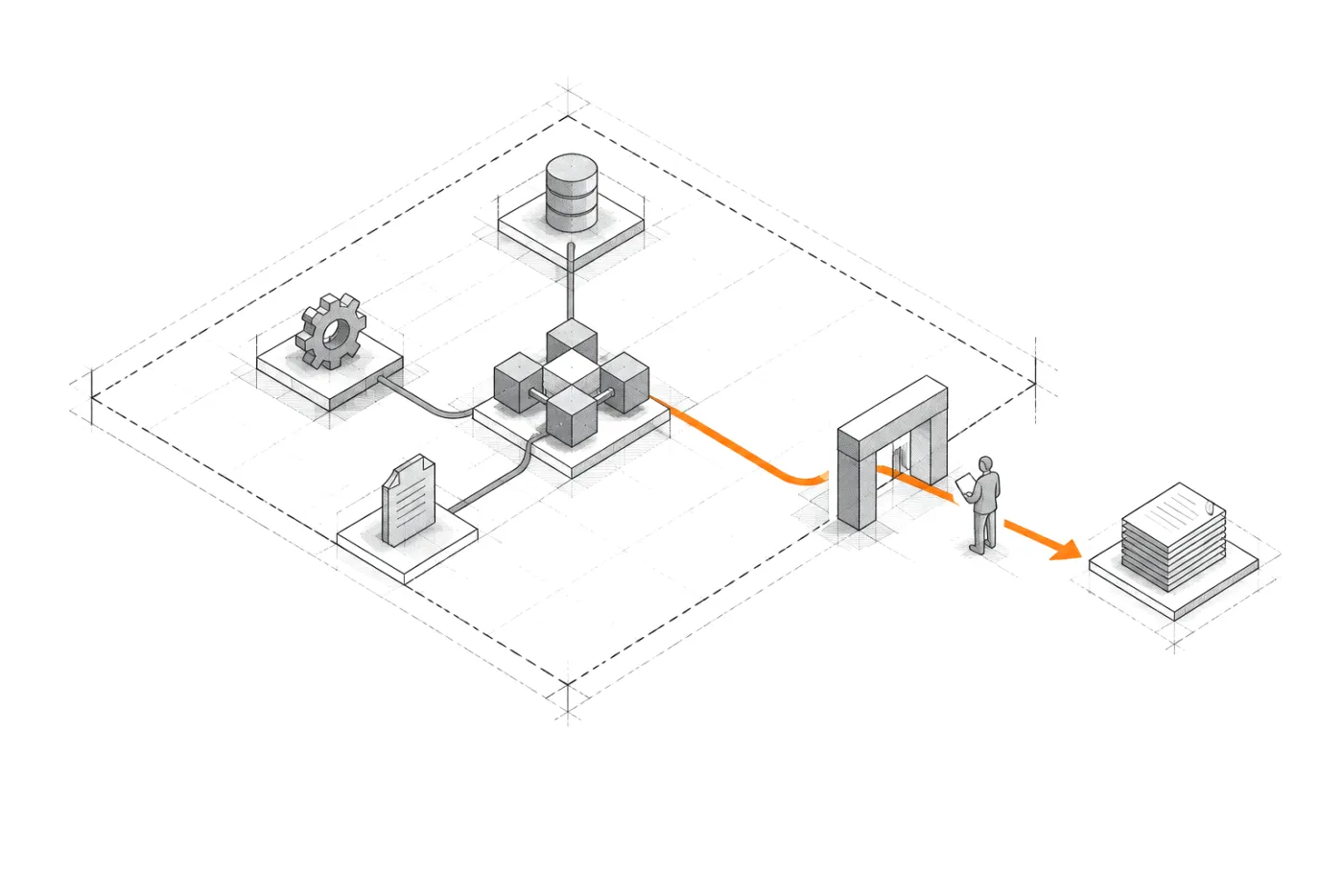
AI as one layer of the systemThe task, your own data, business rules and human review converge in a system that produces answers, automation and alerts.01TASK02OWN DATA03RULES04HUMAN REVIEWSYSTEMANSWERSAUTOMATIONALERTSAI as one layer of the systemThe task, your own data, business rules and human review converge in a system that produces answers, automation and alerts.TASKOWN DATARULESHUMAN REVIEWSYSTEMANSWERSAUTOMATIONALERTS

02 / AI ≠ STRATEGY

AI where it improves the system. Software where it is the better answer.

Artificial intelligence is one more tool in the system, not the goal.

IFTHEN
AI ADDS VALUEAI adds a real capability
USE AIArtificial intelligence
SOFTWARE IS ENOUGHClear logic solves it better
USE SOFTWAREConventional software
BOTH ARE NEEDEDThe problem needs both
INTEGRATE BOTHA system that combines them
FIG. 02Closed scope, bounded tools, a person in the loop
A model with three tools inside a closed perimeter and a person reviewing the output

03 / FIT

Where AI adds value. And where it does not.

Saying no to AI in one part of the system is also an architectural decision.

USE AI

Where it helps

  • Asking questions in natural language about your own data or documents.
  • Summarizing, classifying or extracting information from text.
  • Tasks with too much variation to solve with fixed rules.
  • First drafts that a person reviews afterwards.

USE SOFTWARE

Where it is not needed

  • Calculations that have to be exact: the server does them.
  • Clear business rules: conventional software is more reliable and cheaper.
  • Decisions with consequences and no human supervision.
  • Processes without good data behind them: that has to be fixed first.

04 / WHAT I BUILD

What I build with AI and automation.

Only capabilities I have taken into real systems. Each one links to its evidence.

  • 01

    Assistants over your own data and archives

    Natural-language answers about your company’s information, with sources where possible and bounded access.

    EvidenceRocio.com · AtalayaIQ

    AI chatbot for businesses
  • 02

    Process automation

    Queues, scheduled jobs and workflows that remove repetitive work. With or without AI, depending on what each step needs.

    EvidenceRocio.com

    Business process automation
  • 03

    Models with bounded tools

    The model chooses an operation from a closed catalogue; the system validates and runs it. Autonomy only where it is safe.

    EvidenceAtalayaIQ

  • 04

    AI inside existing systems

    AI as one more layer of the platform or internal tool your team already uses, not as an isolated chatbot.

    EvidenceRocio.com

  • 05

    Cost and quality measurement

    Cost, latency and ratings for every conversation, so you know what works and what it costs to run.

    EvidenceRocio.com

  • 06

    Evaluation against real cases

    Before an assistant is trusted, it is evaluated with real questions against the real data and the real model.

    EvidenceAtalayaIQ

    AI consulting

05 / EVIDENCE

AI in real systems, with its controls.

Two assistants inside their own systems, each one limited to what its data can support.

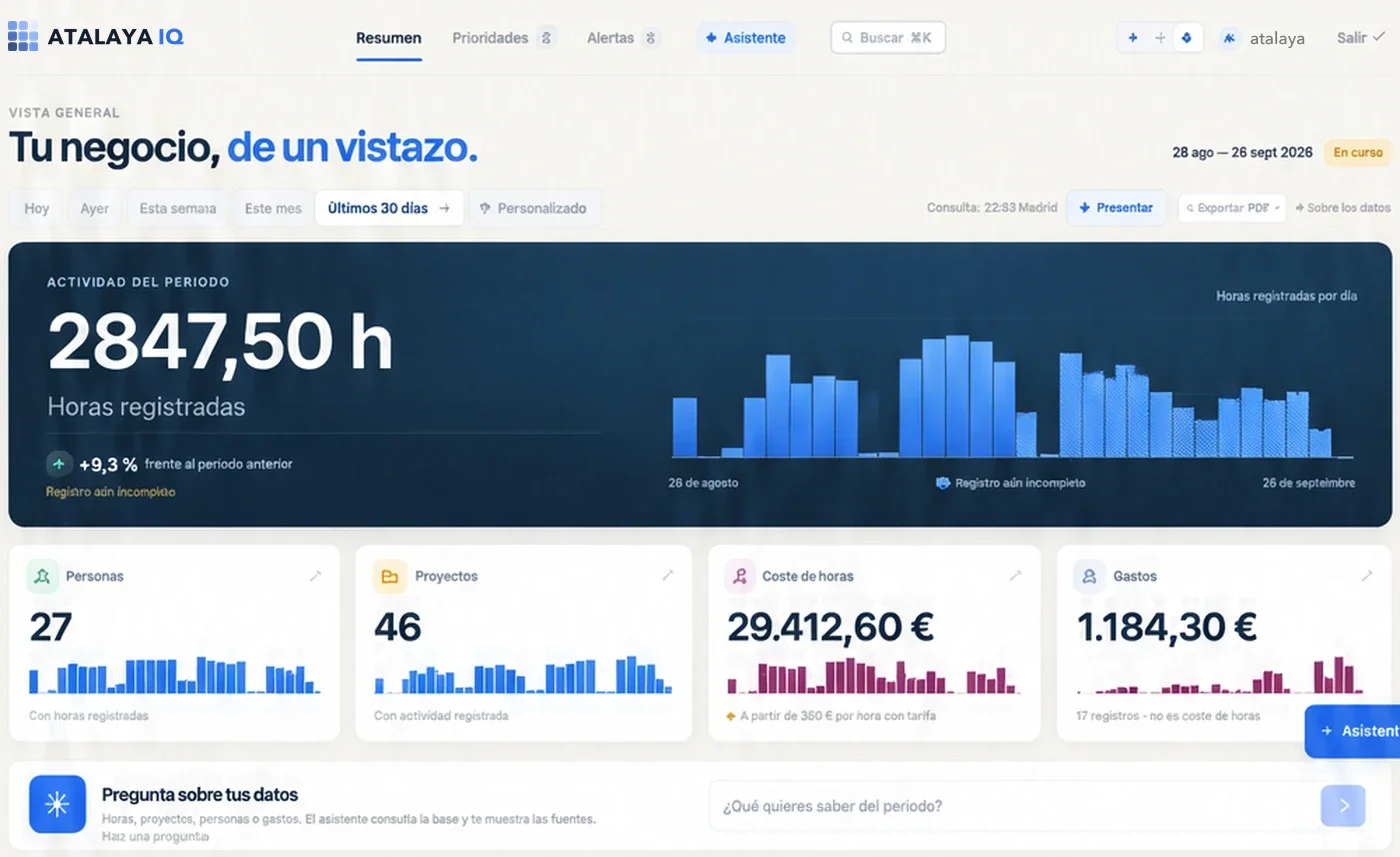
AtalayaIQ overview: hours logged over the last 30 days with their daily series, people, projects, labour cost and expenses.
Overview · last 30 days

Business intelligence

AtalayaIQ

An assistant over business data that can only do what the system allows it to do.

  • The model picks an operation from a closed catalogue; the server validates the parameters and runs fixed, parameterized SQL.
  • The model does not write SQL, and never sees credentials or tables outside the catalogue.
  • Only the question, the text history and aggregated results reach the provider, which does not store the conversations.
  • What the data cannot answer (budget, margin, forecasts) is excluded by design.
  • The assistant is evaluated against the real database and the real model.

STACK Nuxt / Vue / MySQL

Case study: AtalayaIQ

Rocio.com home page: the «El Rocío al completo» guide and a conversational search over more than three decades of archive.
Home page and conversational archive · rocio.com

Editorial platform

Rocio.com

A conversational assistant over more than three decades of archive, built into the platform and measured from the inside.

  • A public conversational assistant over the Rocio.com archive.
  • Answers can come with the archive sources they are based on.
  • An internal conversation viewer with cost, latency and ratings to review quality.
  • A documented decision: no trend analysis until there is enough volume for it to mean something.

STACK Nuxt 4 / Prisma / MariaDB / OpenAI

Case study: Rocio.com

ALSO BUILTRetoQ, a multimodal AI application that scores a photograph against a stable five-criteria rubric, explains why and delivers three edits with exact Lightroom values and importable .xmp presets. The model proposes; the server calculates the score and writes the preset.

06 / CONTROLS

Controls that are not optional.

What separates an AI demo from a system your business can rely on.

  1. SCOPE

    Closed scope

    The AI can only do what the system allows, with validated parameters.

  2. DATA

    Minimum data

    Only what is needed to answer goes to the provider, never credentials or dumps.

  3. HUMAN

    Human in the loop

    Decisions with consequences are reviewed by someone on your team.

  4. COST

    Measured cost

    Every query has a known cost from day one.

  5. EVIDENCE

    Grounded conclusions

    Without enough volume, no trends are drawn or presented as facts.

07 / AGENCY OR ARCHITECT

An AI automation agency or an architect who builds it?

Many automation agencies build flows in Make, Zapier or n8n. Sometimes that’s exactly what’s needed. This is the dividing line.

Building it into your systems pays off if…

  • The automation has to read from and write to your systems (ERP, CRM, database), not just move data between well-known apps.
  • There are business rules of your own, sensitive data or volume that a Make or Zapier flow won’t handle well.
  • You need someone accountable for the system afterwards: changes, errors and cost.

A Make or Zapier flow is enough if…

  • It’s about connecting two or three well-known tools with simple steps.
  • You want to test an idea in days and don’t mind rebuilding it later.
  • The flow doesn’t touch sensitive data or critical processes.

08 / PROCESS

You bring the problem. I design and build the system.

You do not need to arrive with a solution, or know which technology you need.

  1. 01 — PROBLEM

    What is not working, what costs too much, or what cannot be done today.

  2. 02 — DATA

    What information exists, where it lives and what state it is in.

  3. 03 — CONSTRAINTS

    Budget, deadlines, existing systems, team and regulation.

  4. 04 — OBJECTIVE

    What has to happen for the system to be worth it.

  5. 05 — SYSTEM

    I design and build the system, and keep supporting it after launch.

How I work

09 / QUESTIONS

Questions about AI automation.

01

What is AI automation?

Using artificial intelligence inside an automated process for the steps rules can’t cover: understanding text, classifying documents, extracting data or drafting. The rest of the process stays conventional software, and anything with consequences is approved by a person.

02

What can artificial intelligence do for a business like mine?

Mainly three things: answer questions about your own data and documents, remove repetitive manual work, and prepare work so a person can decide faster. What it shouldn’t do is calculate what has to be exact or decide alone on anything with consequences.

Chatbot for businesses
03

How do you decide whether a process needs AI?

I start with what your business needs to do better, not with the technology. If a clear rule solves it, conventional software is used; if there is language, variation or volume that rules cannot cover, AI can help. Many systems combine both.

When NOT to use artificial intelligence
04

What is an AI agent, and when does it make sense?

A system in which the model decides which action to run among several available ones. It makes sense when those actions are bounded and validated. In AtalayaIQ, for example, the model chooses from a closed catalogue of queries and the server validates and runs each one.

Read the AtalayaIQ case study
05

What about data privacy?

What information goes to the AI provider, and what does not, is decided explicitly. In AtalayaIQ only the question, the text history and aggregated results are sent, and the provider does not store the conversations.

06

Which models and providers do you use?

Whichever fits the task, the cost and the data-use terms best. I design the integration so the provider is a configurable part of the system, not a hidden dependency.

07

Can the AI be wrong?

Yes. That is why exact calculations are done by the server, answers are grounded in sources where possible, and decisions with consequences go through a person.

08

How much does it cost to run AI in production?

It depends on usage volume and on the model. That is why the cost of every query is measured from the start: you know what it costs before it becomes a problem.

10 / SAME SYSTEM

Other layers of the same system.

Software, data and AI are not separate services. They are designed to work together.

All systems

What should your business do better?

Tell me about the process, the data and the objective. If the answer is AI, we will build it in with controls. If it is not, I will tell you that too.