CATEGORY / DIGITAL ARCHITECT
What is a Digital Architect?
A Digital Architect turns a business problem into a working digital system by connecting software, data, automation and artificial intelligence under one architecture.
02 / THE PROBLEM
The problem a Digital Architect solves.
Businesses rarely have a tool problem. They have a fit problem: pieces that work on their own, and a system nobody has designed.
- 01Every tool solves its own part and nobody is responsible for how they fit together.
- 02The same data lives in three places and each one tells a different story.
- 03There is one vendor for the website, another for the CRM, another for data and another for AI.
- 04AI is added to a process that nobody had understood or organized first.
- 05Nobody can explain the whole system from end to end.
03 / PROBLEM → SYSTEM
From a business problem to a working system.
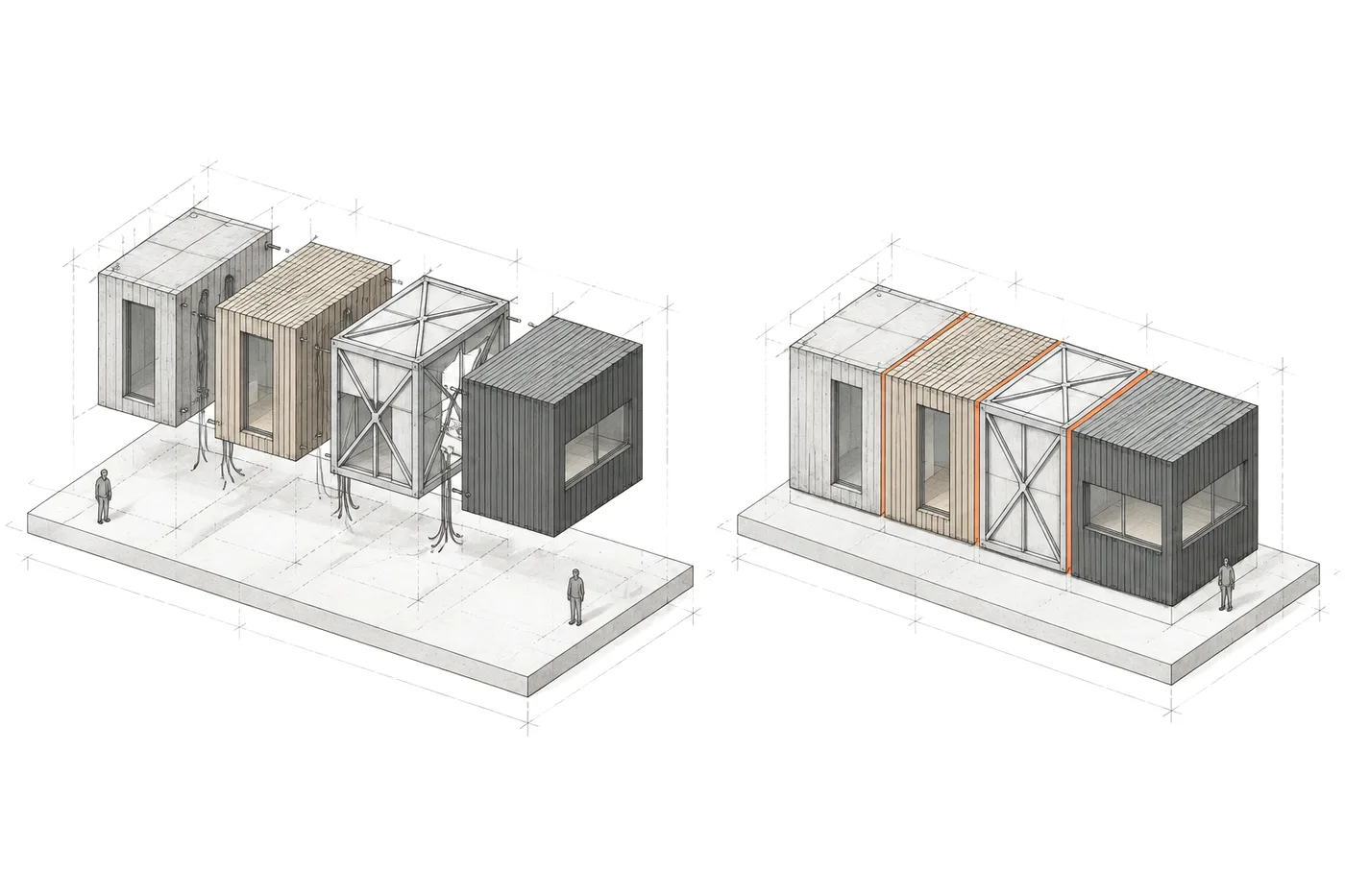
You bring the problem, the data, the constraints and the objective. The Digital Architect turns them into one system and answers for how the pieces fit.
- 01 — PROBLEM
The problem
What is not working, what costs too much or what cannot be done today.
- 02 — DATA
The data
What information exists, where it lives and what state it is in.
- 03 — CONSTRAINTS
The constraints
Budget, deadlines, existing systems, team and regulation.
- 04 — OBJECTIVE
The objective
What has to happen for the system to be worth it.
- 05 — SYSTEM
The system
One architecture across software, data, automation and AI, designed and built.
04 / COMPLETE SYSTEM
What designing a complete digital system means.
Not a website, an app or a dashboard. The whole: how information comes in, where it lives, who uses it and what decisions it enables.
- 01 — PROCESS
The process
How the business really works: who does what, with which information and where it gets stuck.
- 02 — DATA MODEL
The data model
What information exists, what each field means and which source is the source of truth.
- 03 — SOFTWARE
The tools
Platforms, panels, integrations and APIs built around the process.
- 04 — INTELLIGENCE
The intelligence
Reports, alerts, rules and AI where they add something that can be checked.
- 05 — OPERATION
The operation
Deployment, permissions, costs, support and evolution once the system is in use.
05 / SOFTWARE × DATA × AI
Three layers designed together.
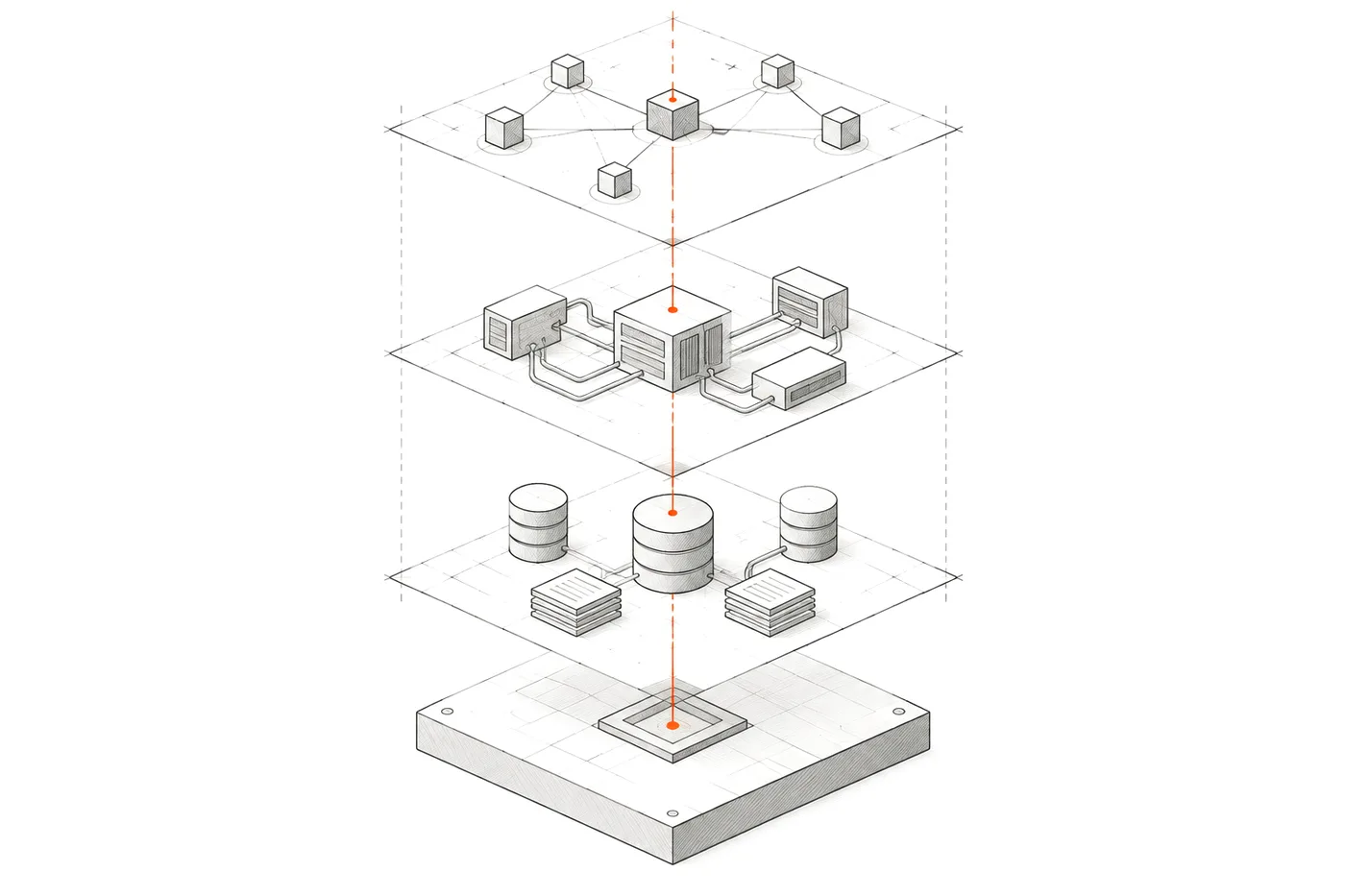
Each one needs the other two. Designing them separately is the most common way to end up with a system that does not fit.
- SOFTWARE
Software
Gives the process its shape: screens, workflows, permissions and integrations. Without it, data is not captured properly and AI has nowhere to act.
Zentia: one platform for several agencies - DATA
Data
Gives the system memory and truth. If the data model is wrong, everything built on top inherits the problem, AI included.
AtalayaIQ: intelligence over seven years of data - AI
Artificial intelligence
Brings judgment to what does not fit in fixed rules: language, images, variation. It works when it rests on organized data and on software that bounds it.
Rocio.com: an assistant over three decades of archive
06 / COMPARISON
How the role compares to others.
All of these roles are necessary. The difference is the scope each one usually covers, not which one is better.
| Role | Main focus | Typical scope |
|---|---|---|
| Developer | Building features and applications. | Usually works from a specification defined by someone else. |
| Software Architect | The technical structure of a software system. | Usually inside a team that implements the design. |
| Technology Consultant | Analysis, recommendations and tool selection. | Usually ends in a recommendation or a plan that others carry out. |
| CTO | Technology strategy and the technical team of one company. | An ongoing leadership role inside the organization. |
| Digital Architect | The whole system around a business problem: process, data, software, automation and AI. | Designs the architecture and builds the system, often without an in-house team. |
07 / WHEN
When a business needs this role.
- 01Your business has grown and standard tools no longer reflect how you work.
- 02You have years of data in an ERP, an in-house system or a CMS and cannot use it.
- 03You want to use AI but do not know where in the process it helps and where it does not.
- 04You need your own system and do not have, or do not yet want, an in-house technical team.
- 05You coordinate several vendors and nobody is accountable for the end result.
- 06An agency has an idea and needs someone to make it technically possible.
08 / EVIDENCE
Systems that show it.
Documented case studies, no invented figures. Each one shows a different combination of the three layers.
- Software · Data · AI
Rocio.com
Migration of an archive dating back to 1992, a normalized data model, an editorial panel and an AI assistant over the archive itself.
Case study: Rocio.com - Data · AI
AtalayaIQ
A read-only intelligence layer over the operational data of a national events company, without migrating its system.
Case study: AtalayaIQ - Software · Data
Zentia
One core for several real-estate agencies, with each agency’s data isolated in the database.
Case study: Zentia - Software · Data · Physical
Event Tech
Physical-digital systems for FITUR, MWC, ITB and WTM: screens, tablets, QR, NFC and data working together.
Case study: Event Tech
09 / QUESTIONS
Questions about the Digital Architect role.
01What does a Digital Architect do?
Turns a business problem into a working digital system: understands the process, defines the data model, builds the tools and brings in automation and AI where they add value. The role covers the whole system, not a single piece.
02Is it the same as a software architect?
Not exactly. A software architect usually designs the technical structure inside a team that implements it. A Digital Architect starts from the business problem and the data, and also builds the system.
03Does a Digital Architect replace a CTO?
No. A CTO leads a company’s technology strategy and team on an ongoing basis. A Digital Architect can design and build the systems that strategy needs, or do so before the company has a CTO.
04Why does integrating disciplines matter more with AI?
Because AI depends on everything else: organized data, software that bounds it and a process that has been understood first. With coding agents, building is faster; deciding well what to build and how it fits becomes the hard part.
05How does a project with a Digital Architect start?
With the problem, not the solution. You tell me what is not working, what data you have, what constraints exist and what the system has to achieve.
Tell me what you need to solveWhat system does your business need?
Tell me the problem, the data you have, the constraints and the objective. You do not need to know yet what has to be built.