METHOD / PROBLEM → SYSTEM
Give me the problem.
I design and build the system.
You bring the problem, the data, the constraints and the outcome you need. I decide what to build, how the pieces fit together and which technology makes sense.
02 / INPUTS
PROBLEM · DATA · CONSTRAINTS · OBJECTIVE → SYSTEM
These are the questions I will ask you. You do not need every answer: finding them is also part of the work.
- 01 — PROBLEM
The problem
- What is not working today?
- What costs too much time or money?
- What cannot be done today but should be possible?
- 02 — DATA
The data
- What information exists, and where does it live?
- Which tools and systems are involved?
- What state is that data in?
- 03 — CONSTRAINTS
The constraints
- What budget and deadlines are there?
- What has to keep working as it is?
- Are there regulations, teams or vendors that set limits?
- 04 — OBJECTIVE
The objective
- What has to happen for this to be worth it?
- Who will use the system, and for what?
- How will we know it works?
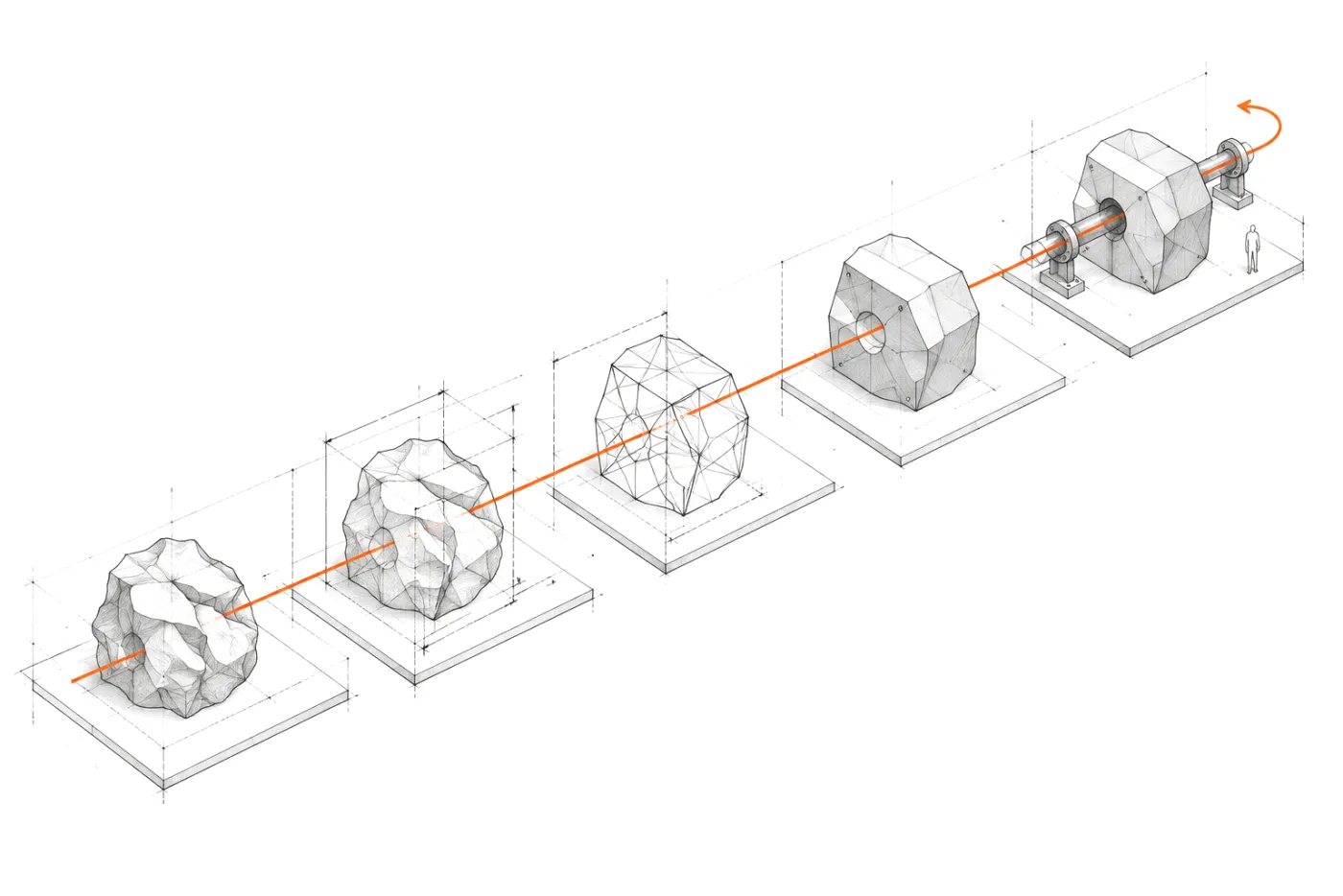
03 / PHASES
From the first conversation to a system in production.
Six phases. The first one can end with «nothing needs to be built».
- 01 — UNDERSTAND
Understand
Understand the business problem before choosing technology. If nothing needs to be built, you hear it here.
- 02 — DESIGN
Design
Architecture, data model, integrations, boundaries and priorities. What to build, in what order and, above all, what not to build.
- 03 — BUILD
Build
Build the system in small, verifiable pieces, with AI as an execution tool and judgment as the guide.
- 04 — VERIFY
Verify
Test it against real data, real workflows and real constraints before anything is considered done.
- 05 — HAND OVER
Hand over
The repository, credentials and data belong to the client. You own the system from day one.
- 06 — EVOLVE
Evolve
A useful system keeps changing as the business changes. I can keep supporting it after launch.
04 / RESPONSIBILITY
AI increases execution capacity. It does not replace architectural responsibility.
Coding agents let one person build far more than before. Someone still has to decide what to build, how it fits and whether it tells the truth.
The leverage has changed. The responsibility has not.
- A direct relationship with Andrés. You talk to the person who designs the system, builds it and answers for it.
- No account-manager layer. No sales team and no hand-offs between people who each hold part of the context.
- Architecture before implementation. The data model and the boundaries are decided before code multiplies them.
- Integrate before replacing, when that is the better decision. What already works is kept and connected; migrating is a choice, not a requirement.
- AI only where it is useful. Each part of the system uses the right tool, with or without AI.
- Evidence over assumptions. Numbers are reconciled against the source before they are shown, and nothing is claimed that the data cannot support.
- Client ownership. The repository, credentials and data belong to the client. No hidden dependencies.
05 / PRINCIPLES
What does not change from project to project.
Decisions in writing
Structural decisions are recorded with their context and consequences.
Evidence: Rocio.com architecture decisionsVerified with real data
Figures are reconciled against the source before they are shown.
Evidence: AtalayaIQ reconciliationIntegrate before replacing
Read the data where it already lives. Migration is a decision, not a requirement.
Evidence: AtalayaIQ, read-onlyIsolation where it belongs
Security rules live in the database, not only in the interface.
Evidence: Zentia, RLS per agencyDesigned for the real environment
Devices, connectivity and who operates the system are decided at the start.
Evidence: Event Tech at FITUR, MWC, ITB and WTMNo invented numbers
Not in the system and not in the proposal: what the data cannot support is not claimed.
06 / QUESTIONS
Questions about how I work.
01Do I need to know which technology I want?
No. You need to know what problem you have and what you want to achieve. Choosing the technology is part of my job.
02How does a project start?
With the contact form or an email describing the problem. I read it myself, ask about anything that is unclear and, if it makes sense, we talk it through before I propose anything.
Tell me the problem03Do you work alone?
Yes: the person who designs the system is the person who builds it. I work with coding agents that extend what one person can build, but the decisions and the responsibility are mine.
Meet Andrés04What changes when you build with AI?
Writing code is much faster and cheaper. What does not get cheaper is deciding what to build, designing the data, integrating the pieces and verifying that the system tells the truth. That is where the work is now.
What is a Digital Architect?05What size of project is a good fit?
Systems with a real problem behind them: platforms, internal tools, data layers or embedded AI. The contact form includes indicative budget ranges starting at €5,000; large systems are planned in phases.
06Who owns the result?
You do. The repository and credentials are handed over, and the code and the data belong to your company.
07Do you work with companies outside Spain?
Yes. I am based in Spain and work with companies anywhere, in English or Spanish.
Shall we start with the problem?
Tell me what you need to solve. You do not need to know yet what has to be built.