Business chatbot: when it makes sense and how to make it reliable
When a business chatbot makes sense, what data it needs and how to design it so it answers with evidence instead of improvising.
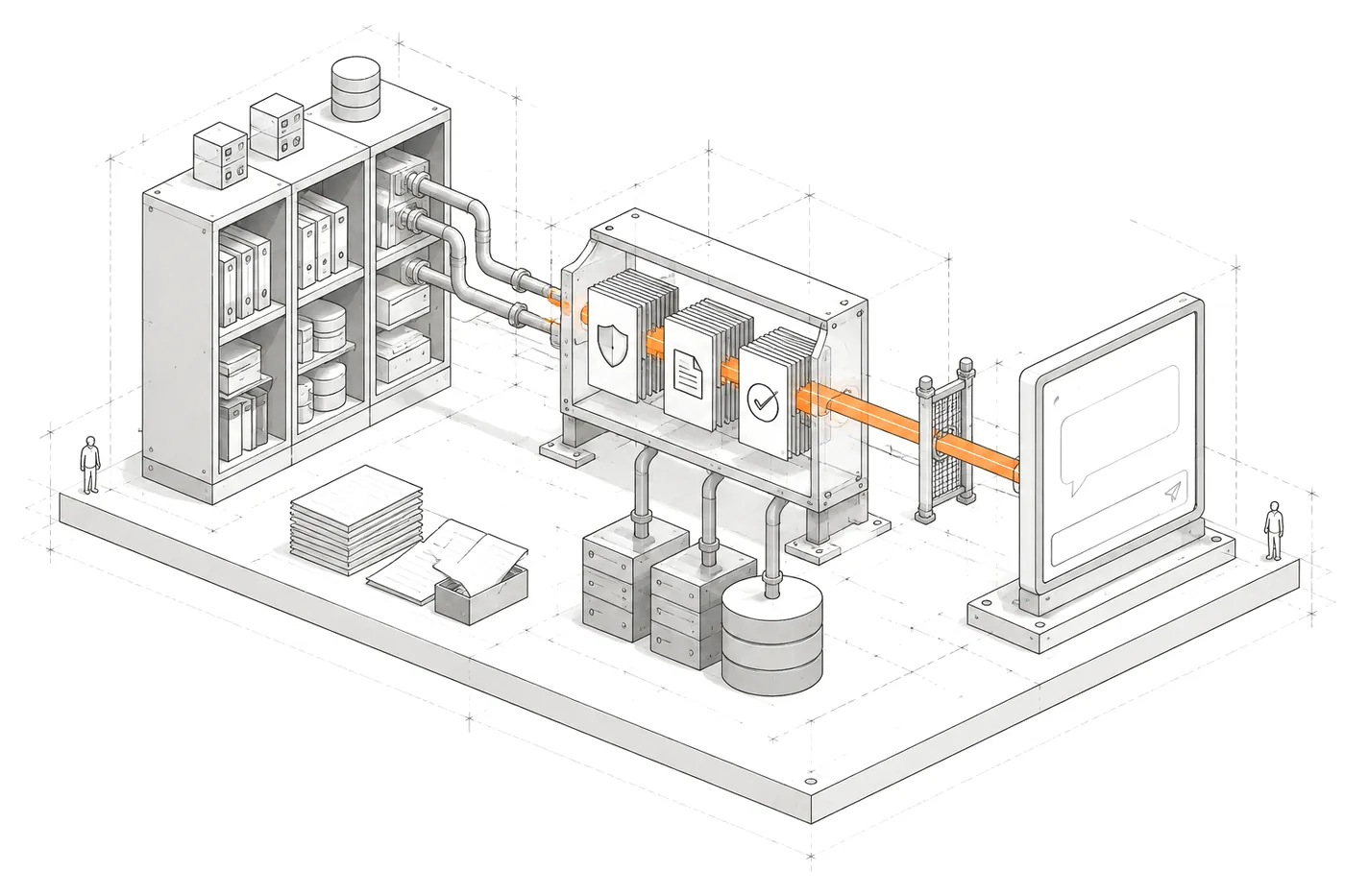
A business chatbot should not start with a chat window. It should start with a harder question: what can the company answer with confidence, and what should it never answer on its own?
Most projects fail before the model is the problem. Not because AI cannot write a convincing answer, but because it has no reliable source, no clear boundary and no way to know when the right answer is to stop.
A business chatbot makes sense when it answers over your own knowledge, with clear limits, traceability and a useful output; not when it is used to hide a process that is still disorganised.
What a business chatbot should actually solve
A business chatbot is not a conversational toy added to a website. Done properly, it is an interface for querying documents, data, policies, catalogues, support issues, procedures or archives that already exist inside the organisation.
It can support customer service, internal support, documentation search, commercial teams, operational reporting or knowledge bases. But in all those cases the important question is the same: where does the answer come from?
If the chatbot answers from a well-defined document base or database, you can design a serious system. If it answers from outdated PDFs, contradictory instructions and whatever the model remembers, it will probably improvise with too much confidence.
That is why I frame a chatbot for businesses as an AI layer over company knowledge, not as a widget. What goes in, what gets indexed, what can be queried, what the user sees and what must be escalated to a person are the product.
When it does make sense
There are situations where a chatbot genuinely reduces friction. Not by replacing people, but by making existing information easier to reach.
It is worth considering when several conditions are true:
- The same questions keep coming back. Customers, sales, operations or management ask for the same information again and again.
- The answer already exists. It lives in documents, procedures, databases, records, tickets or published content.
- The domain is limited. The chatbot does not need to know everything; it needs to answer within a specific context.
- Some answers must be refused. If there is no source or no permission, the system should say it cannot answer.
- The answer leads to something useful. Finding a document, opening a task, preparing a summary, showing evidence or handing over to a person.
The fourth condition is often ignored. A reliable chatbot is not the one that always replies. It is the one that knows when to refuse, ask for more context or escalate.
That is the same principle behind when not to use AI: if you cannot verify the answer, you should not put it in production as if it were operational truth.
The base: sources, data and limits
Before choosing a model, the ground has to be prepared. A business chatbot needs three layers.
The first one is the source of truth. It may be a database, a document repository, a CMS, an ERP, a CRM or a combination of systems. The important decision is which source wins when two sources disagree, and which content stays out.
The second one is the response contract. The chatbot needs to know whether it can answer in free text, whether it must cite sources, whether it can only choose between fixed actions or whether the output must follow a specific format. Explaining an internal policy is not the same as querying the status of a project.
The third one is the security perimeter. Who can ask, which data they can see, what is sent to the AI provider, what is logged and how long it is kept. If the assistant works with internal data, those decisions are not technical details. They define the system.
It is also important to decide what the first version will not do. If a chatbot starts by promising customer support, order status, proposal writing, contract reading and commercial decisions at the same time, the scope is probably wrong.
Example: asking an archive without losing the source
In Rocio.com, the assistant did not appear in isolation. First came the rebuild of an editorial platform with an archive dating back to 1992: 11,596 news articles, 169 brotherhood pages and 47,401 migrated media files.
The important decision was that the database remains the source of truth. The vector index is disposable: it can be rebuilt from MariaDB if the provider or the model changes. No provider identifier lives inside the editorial content.
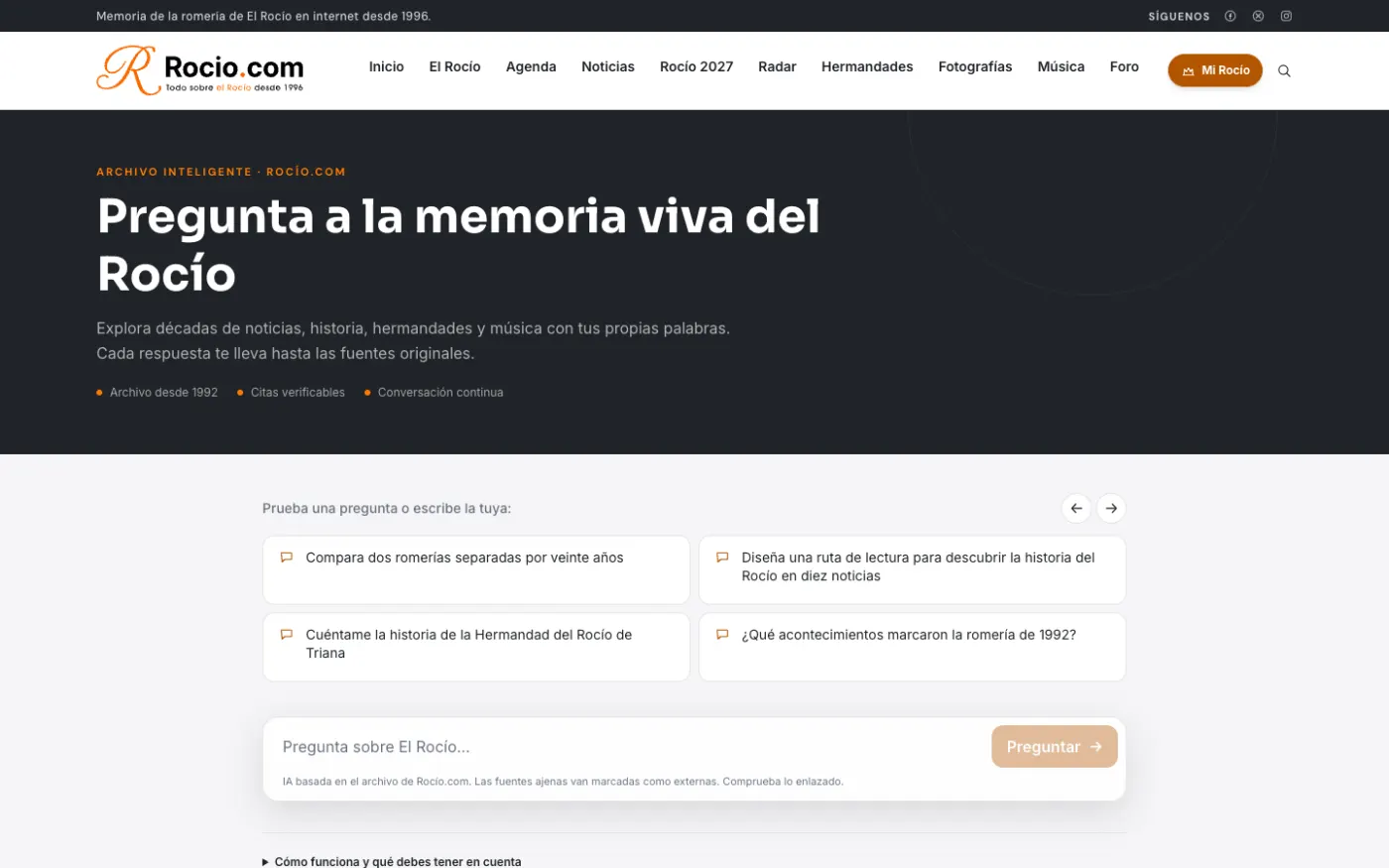
This pattern applies to many companies: manuals, project history, technical documentation, internal policies, editorial content or knowledge accumulated over years. The chatbot does not replace the archive. It makes it queryable.
But that only works if the archive is organised. If the knowledge is duplicated, contradictory or ownerless, the first phase is not adding AI. It is cleaning, structuring and deciding what can be answered.
Example: querying operational data without letting AI invent SQL
AtalayaIQ is a different kind of chatbot: an assistant for asking questions about a daily briefing built over seven years of operational data from a national events company.
The key is not giving the model free access to the database. It is the opposite. The assistant works with a closed catalogue of tools: the model chooses the operation, the server validates the parameters and runs fixed, parameterized SQL. The model does not write SQL, does not see credentials and cannot access tables outside the catalogue.
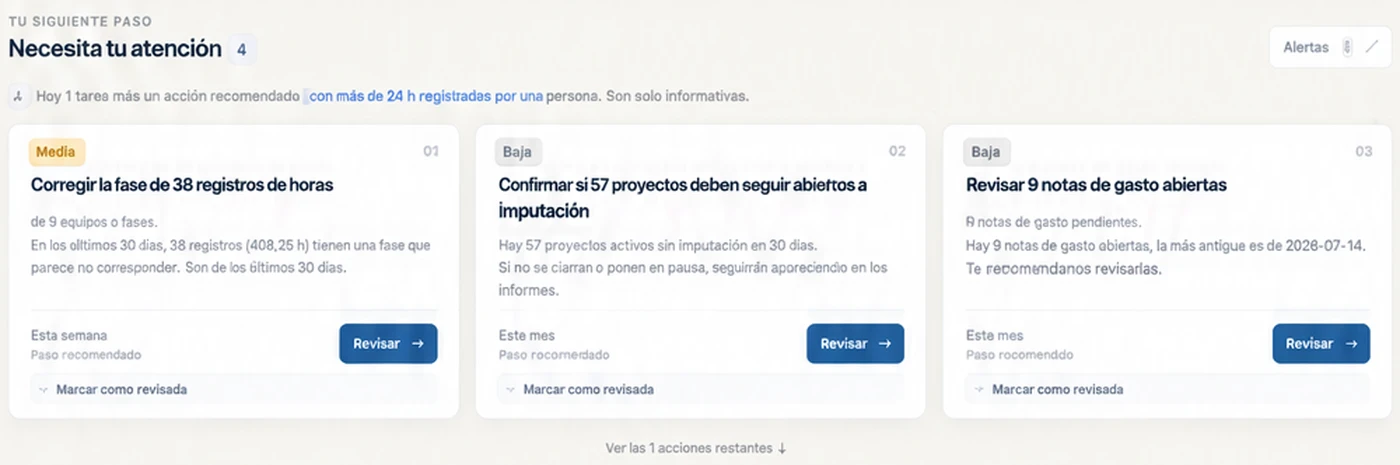
That design avoids a common mistake: turning the chatbot into a superuser of the database. Inside a company, an assistant should have less freedom than an expert person, not more. It can help explore, summarize and explain, but only through permitted operations.
How I would design it before building
I would start with a small, testable map, not with a broad promise of round-the-clock support.
- Question inventory. What is being asked today, who asks it and what happens after the answer.
- Source inventory. Where the answer lives and who resolves conflicts between sources.
- Risk classification. Which questions are informational, which affect customers, which involve sensitive data and which should stay away from AI.
- Response design. Text with sources, fixed action, document link, summary or handover to a person.
- Tests with real cases. Easy questions, ambiguous questions, badly phrased questions and questions the system must refuse.
- Logging and improvement. Review conversations, find gaps in documentation and adjust the perimeter.
The first version should be narrow. A chatbot that answers twenty important questions well is better than one that promises to answer everything and then forces the team to supervise it every day.
When I would not build a chatbot
I would not build one if the company does not yet know what the correct answer is. I would also avoid it when the real problem is a broken process: orders without status, documents without ownership, scattered conditions, exceptions buried in email or decisions that depend on memory.
A chatbot does not fix a poor customer experience either. If the right answer is hard to find because the company has not defined it, AI will only make the disorder sound more polite.
And I would not let it decide on matters with legal, financial or reputational impact without human review and evidence. In those cases, the system can prepare information, summarize documents, flag risks or open a task. Deciding is different.
One more basic point: the assistant should say it is AI. Not as a formality, but because it changes user expectations. Hiding that fact does not make the assistant smarter; it only makes it less honest.
A business chatbot is not a mouth that always answers. It is a controlled door into knowledge the company can stand behind.
If your team receives repeated questions, works with scattered documentation or cannot query internal data without asking someone else, the chatbot for businesses page explains how I approach these systems: sources first, clear limits and a first version that can be tested with real questions.