A QR code isn’t a sticker: it’s a door
Before putting a QR code on an event piece, there’s one question worth asking. Because scanning is easy. The tricky part starts right after.
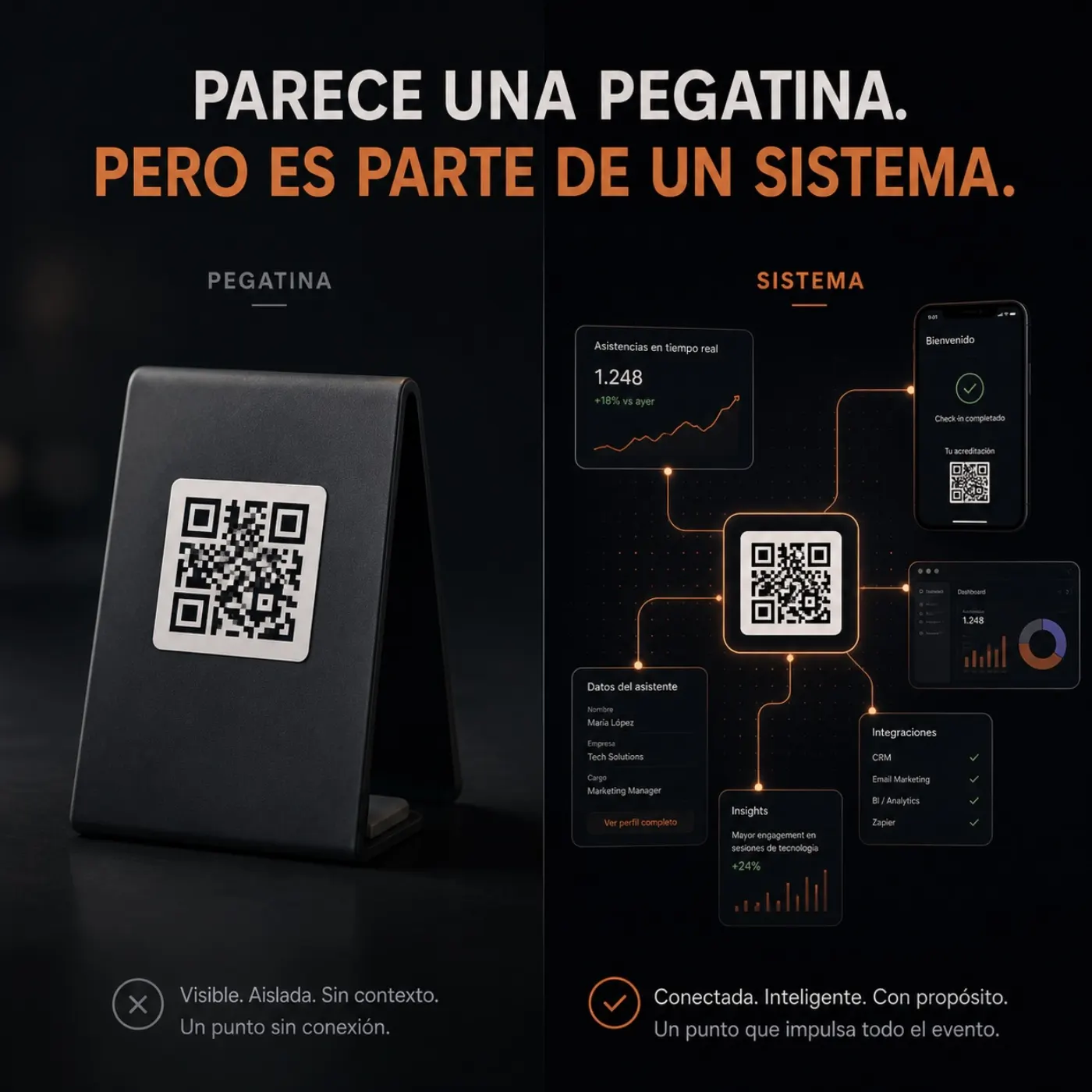
In an event proposal, a QR code usually takes up very little space. Sometimes it appears at the end of a slide, gets added to a graphic piece, or someone says: “let’s put a QR code up and people can go in”. It looks like a minor, almost decorative decision.
But on a real stand, a QR code is rarely just a QR code.
It’s a door. And like any door, what matters isn’t only that it exists. What matters is knowing where it leads, what happens when you walk through it and whether the experience on the other side has been designed for the real context of the event.
Because scanning is easy. The tricky part starts right after.
The moment everything gets complicated
The visitor takes out their phone, opens the camera, points at the code and goes in. Up to there, everything seems simple. But at that instant a lot of decisions kick in that haven’t always been designed in enough detail: what they see first, how long it takes to load, what data they’re asked for, what happens if they don’t want to register, if they have a poor connection, if they’re using an old phone, if the form is too long or if they don’t understand what they get out of taking part.
On a desktop, a website can get away with some detours. At an event, it can’t.
The visitor is standing up, surrounded by noise, stimuli, screens and little time. They aren’t sitting down calmly exploring an interface. They’re on the move. That’s why the experience after the QR code has to be immediate, clear and very specific.
The most common mistake: confusing the entry point with the solution
That’s where many digital activations go wrong: the QR code is treated as a solution, when it’s really only the entry point.
It can lead to a vote, a booking, a brochure download, a gamified activity, a networking system, a personalised experience or a lead-capture form. But each of those destinations needs different logic.
A QR code to download a PDF isn’t the same as one to book a table. Taking part in a quiz isn’t the same as updating a screen in real time. Asking for an email isn’t the same as asking for name, company, job title, phone number and legal consent.
In a sales presentation everything looks linear. On the stand, every bit of friction shows.
If the QR code opens a slow page, the visitor leaves. If the form asks for too much, they give up. If there’s no clear reward, they don’t take part. If the staff can’t explain what it’s for, the code becomes just another decoration.
Thinking of the QR code as part of an architecture
That’s why it’s worth thinking of the QR code as part of an architecture. It doesn’t have to be complex, but it does have to be coherent. Before putting it on a piece, you should be able to answer these questions:
- What does the visitor do? Do they just scan, or is there a follow-up action?
- What do they get in return? Is there a clear incentive to take part?
- What data gets recorded? Who looks at it, and when?
- What happens if the network fails? Is there a plan B?
- What metrics can be seen afterwards? Will the client get a report?
- What content can be changed during the event? Or is everything fixed from build-up?
These questions don’t complicate the project. They ground it.
The difference is whether it’s thought through before or after
A QR code may look small within a proposal, but it can shape the whole digital experience. It can be the entrance to a very simple layer or to a more ambitious system. It can be a forgotten sticker on a totem or the first gesture of a well-designed experience.
The difference is whether it’s thought through before or after. And at events, “after” is usually too late.
So, before putting a QR code on a piece, it’s worth asking a simple question:
Does this door lead somewhere worth going?
If the answer isn’t clear, we don’t have a digital activation yet.
We have a sticker.
Designing what happens on the other side of that door is part of what I do as a technology partner for agencies, and I walk through a specific case in your FITUR 2027 stand: plan the digital side now.