Your agency doesn’t need to be a software house
Agencies increasingly sell apps, totems, QR/NFC, screens and networking. They don’t need to become a software company to do it well.
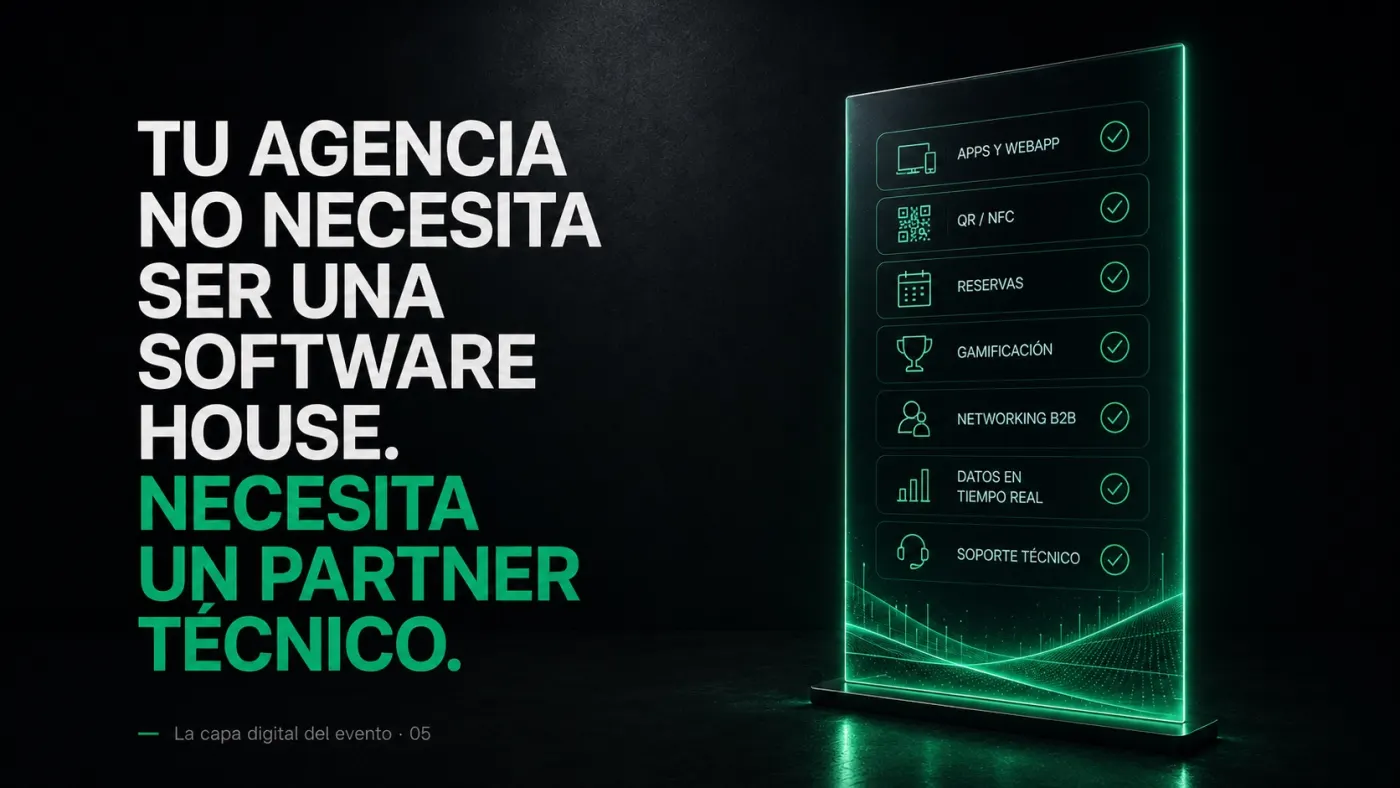
Event agencies are getting more and more digital briefs.
Years ago, many proposals could be handled with set design, production, audiovisual content, graphic design, lighting, furniture, staff and coordination. All of that is still essential. But now, more and more often, an extra layer appears.
An attendee app. An interactive totem. A booking system. A QR activity. An NFC experience. A video wall connected to data. A real-time leaderboard. A networking platform. A staff panel. A lead-capture tool. A dashboard showing stand activity.
And then the agency finds itself on uncomfortable ground.
Not because it doesn’t understand the idea. It usually understands it very well. The agency knows what the client wants, what story has to be built, what experience it wants to create and how the space should feel.
The problem is a different one: delivery starts to brush against the world of software.
An agency’s value isn’t in becoming a software house
An event agency doesn’t have to become a software house. It shouldn’t, if that isn’t its business.
Its value lies elsewhere: understanding the client, building the proposal, directing the creative, coordinating production, looking after the experience, managing timelines, negotiating with suppliers, solving the unexpected and making everything come together on the day.
That’s complex enough already.
But when the proposal includes a digital layer, the agency needs someone it can rely on to turn that idea into a feasible architecture.
Not to replace it.
To strengthen it.
Technology should serve the experience
A good technical partner doesn’t come in to impose technology. They come in to listen to the idea, spot risks, organise flows, define which pieces are needed and build what’s necessary for the experience to work.
Sometimes it’ll be a web app. Sometimes a backend. Sometimes an admin panel. Sometimes a 4K screen. Sometimes a system connected to tablets, QR, NFC or forms. Sometimes a simple integration. Sometimes a more complex piece that has to handle real-time data.
But the logic should always be the same: technology serving the experience.
The digital layer shouldn’t swallow the creative idea or turn the project into a technical artefact that’s hard to explain. It should make the proposal clearer, more useful, more measurable or easier to run.
What the agency gains by adding technical judgement
For the agency, adding a specialist technical partner has several advantages.
The first is being able to sell more without taking on the whole technical load internally. If a client asks for “something digital”, the agency doesn’t have to turn it down out of fear or promise it blindly. It can explore it with judgement.
The second is reducing risk. Many complications appear when the technical team comes in too late, with the proposal already sold and little room to rethink. With a technical read from the start, it’s easier to adjust scope, timelines and budget.
The third is improving the quality of the proposal. A well-planned digital activation doesn’t just sound appealing. It’s easier to understand. It has a flow, a function and a purpose within the stand. That helps defend it to the end client.
And the fourth is protecting the agency’s relationship with its client. Because at events, when something fails, it isn’t always clear who did what. The client looks at the agency. That’s why the technical layer has to be well thought out, even if it then runs in the background.
Visible or invisible, but well integrated
This point matters: a technical partner can work visibly or invisibly.
They can appear as a specialist collaborator, if that strengthens the proposal with the client. Or they can work under the agency’s brand, if the commercial relationship calls for it.
What matters isn’t the spotlight. What matters is that the proposal reaches the event as something solid.
The agency doesn’t need developers for everything. It needs technical judgement close at hand when the idea demands it.
Because the digital side of an event is no longer always a decorative extra. More and more, it’s part of the value the client expects: participation, data, personalisation, interaction, operational efficiency and a more memorable experience.
But that layer has to be designed well.
Not at the end. Not when everything has already been sold. Not as a last-minute add-on.
From the start.
A collaboration that can change the delivery
An event agency doesn’t have to become a software house.
But it can have a technical ally that lets it sell, build and deliver digital activations with more confidence.
And in a sector where the gap between a good idea and a good delivery can be huge, that collaboration can make much more of a difference than it seems.
The agency keeps the relationship, the creative and the direction. The technical layer should help the idea reach the event alive.
If your agency needs that technical ally, technology partner for agencies explains how I work: what I take on, what the agency keeps and which projects I’ve been part of, from FITUR to MWC.