Before selling a digital activation, make sure it can be delivered
An interactive idea can sound great in a proposal, but before selling it, pin down feasibility, scope, devices, risks and real production.
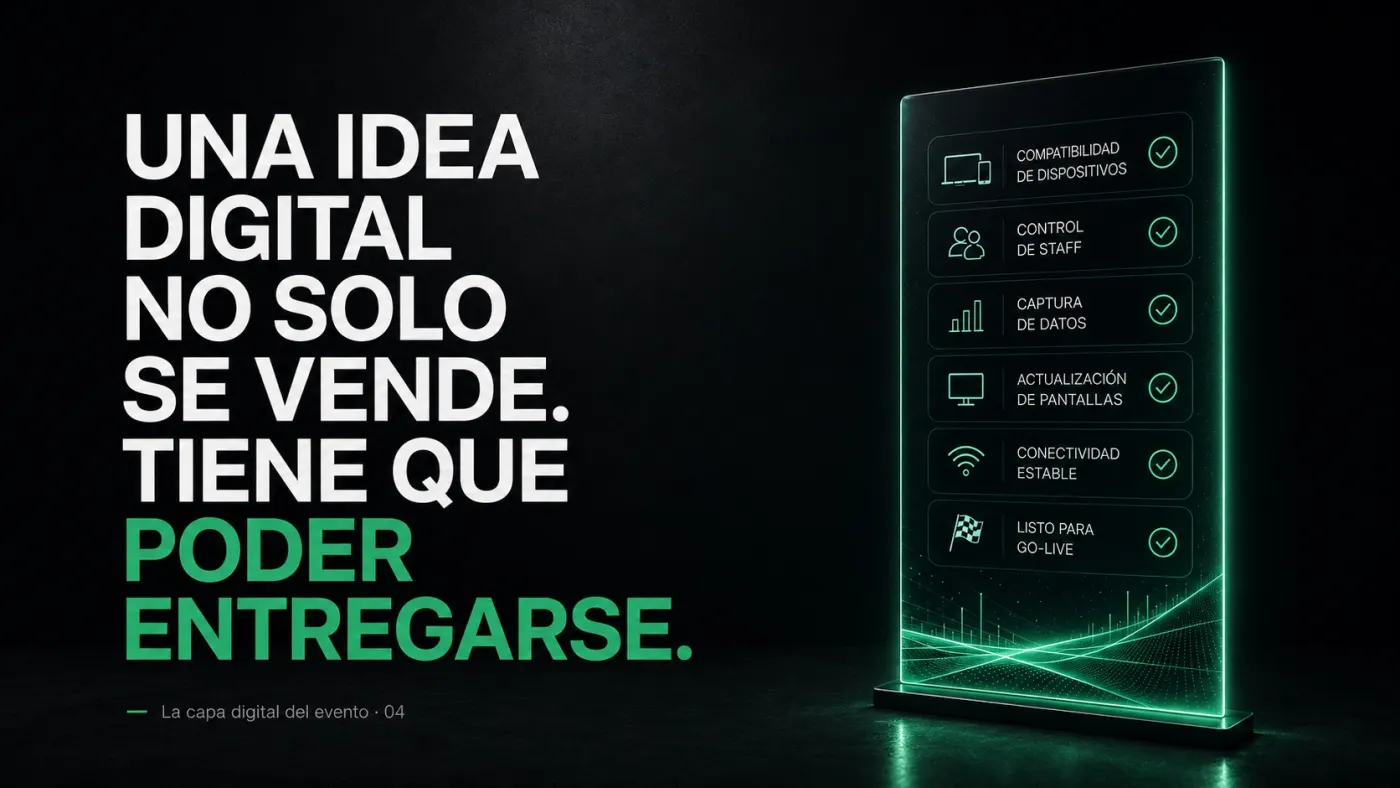
“We could do something interactive.”
It’s a common line in event proposals. And it makes sense. It opens up possibilities, sounds appealing and lets everyone imagine a richer experience than a purely exhibition stand.
The problem is that “interactive” can mean far too many things.
It can be a QR code, an app, a totem, a touchscreen, a voting activity, a booking system, a gamified experience, a data visualisation, an NFC piece, a leaderboard, a smart form or a personalised journey.
All of that can be interactive.
But not all of it needs the same complexity, the same time, the same budget or the same level of risk.
That’s where it pays to get specific early. Not to kill the idea. Quite the opposite: to protect it.
A digital activation doesn’t become less creative because someone asks how it’s going to work. It becomes easier to sell, to budget and to deliver.
An idea can sound simple until it reaches the stand
At proposal stage, many ideas seem simple because they still live in words.
“The visitor takes part and appears on screen.” “People scan and book.” “Every user gets a personalised experience.” “Staff can see the data in real time.”
Those are clear, appealing sentences. But each one contains technical and operational decisions worth settling before promising too much.
Who takes part. From which device. What data they enter. What they see next. What the stand team needs. What information is shown publicly. What’s kept private. What happens with a poor connection. Which part has to work offline. Which content can be edited. What happens if the client changes something the day before. What gets tested before build-up.
These questions aren’t bureaucracy.
They’re production.
The difference between an activation that looks good in a presentation and one that works at a real event usually lies in details like these.
The event doesn’t wait
When the stand opens, the experience has to be ready.
You can’t improvise an architecture in the middle of the hall. You can’t discover live that the form asks for too much data, that the screen is slow to update or that nobody knows how to restart a stuck flow.
In digital there’s always some uncertainty. But at events you have to reduce it as much as possible beforehand.
That doesn’t mean every activation has to be a big system. Sometimes a simple, well-thought-out solution beats an ambitious idea that was never properly closed.
A QR code with a clear flow can work better than an unnecessary app. A screen with three well-chosen figures can add more than a dashboard full of metrics. A staff tablet with two simple actions can be more useful than a complex panel nobody will use.
The key is matching ambition, context and delivery.
Feasibility is a sales tool too
There’s an important commercial point: when an agency sells a digital activation without being clear on its feasibility, it takes on a risk it may not have calculated.
The client buys a promise. Production inherits uncertainty. And the technical team comes in late, when expectations are set, the budget is closed and there’s little room to rethink the approach.
That’s dangerous.
It’s much better to bring technical judgement in before the proposal is closed. The creative phase doesn’t need to become an audit. A first read is enough: what can be built, what should be simplified, which parts are critical, what dependencies exist and what should really be budgeted for.
That early work can save a lot of problems later.
And it helps sell better.
Because a well-grounded digital proposal conveys confidence. It doesn’t just say “we can do this”. It explains, even simply, why it makes sense, how it will fit into the stand and what value it brings to the visitor, the client and the agency.
Technical feasibility shouldn’t be seen as a brake.
It should be seen as a sales tool.
A digital idea isn’t better for sounding sophisticated
A digital idea isn’t better because it sounds sophisticated. It’s better when it can be experienced without friction, run without chaos and delivered without surprises.
At events, creativity needs something very unglamorous: for it to work.
And the sooner that’s considered, the better the idea’s chances of reaching the stand alive.
Before selling a digital activation, you don’t need everything closed. But you do need to know it can be delivered.
That early validation is exactly what I do as a technology partner for agencies: I review the idea before it’s sold and, if it goes ahead, I build it and run it at the event. If the show is FITUR, the timeline is in your FITUR 2027 stand: plan the digital side now.