A stand with technology is a small system running live
When the digital side gains weight, a stand stops being a collection of screens, apps or totems: it becomes a live system that has to work in a real context.
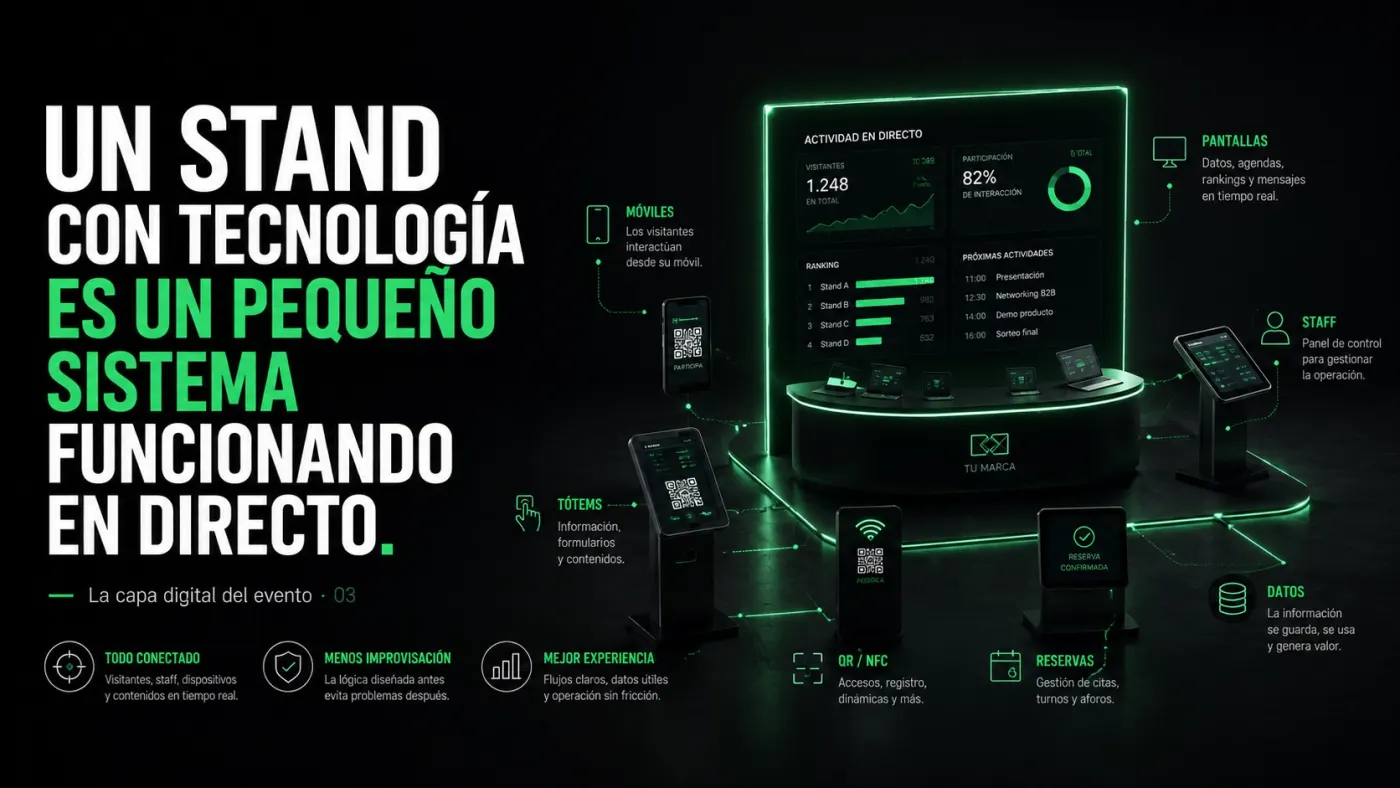
A stand with technology isn’t simply a stand with screens.
Nor is it a standalone app, an isolated totem, a QR form or a tablet placed on a counter. When the digital side starts to carry some weight, the stand becomes something closer to a small system running live.
And that word, “live”, changes everything.
On a corporate website, if something isn’t perfect, you can fix it the next day. In an internal application, you can adjust a flow after testing it with users. In an online shop, you can measure, iterate, optimise and roll out improvements.
At an event, the margin is much smaller.
The stand opens at a set time. The client arrives. The team is there. The screens come on. Visitors start walking past. And if something fails, it doesn’t fail in the abstract: it fails in front of people, brands, production managers and decision-makers.
Working technically isn’t enough
Digital activations for events have a special nature. It isn’t enough for something to work locally, in a demo or in a controlled test. It has to work in context.
With noise. In a hurry. With visitors who don’t know what to do. With staff who can’t spend every five minutes solving technical problems. With patchy networks. With different devices. With screens that have to read well from a distance. With content that may change the day before. With a tight build-up and a pressure that doesn’t always show up in the creative phase.
That’s where a digital activation stops being a piece and becomes an operation.
Take an apparently simple flow: a visitor scans a QR code, registers, takes part in an activity and their result appears on a screen.
On paper it looks easy.
But underneath there are lots of small decisions: what data is asked for, how the form is validated, whether there’s legal consent, how duplicate entries are prevented, what message the user sees at the end, how long the screen takes to update, what happens if the network drops, whether the data is stored, whether the client can export it afterwards or whether the staff have a panel to control what’s going on.
Every detail matters because they’re all part of the same experience.
When loose pieces start forming an architecture
The same goes for table bookings, B2B networking, brochure totems, 4K screens, NFC systems, mobile apps or stand dashboards. On their own they may seem manageable. Together they form an architecture.
Not necessarily a huge one, but a logic.
And that logic has to be designed before arriving at the venue.
One of the most important things in this kind of project is understanding who uses each part. The visitor doesn’t need the same as the staff. The end client doesn’t need the same as the agency. The technical team doesn’t need the same as production.
A good activation draws those roles clearly:
- The visitor needs clarity.
- The staff need control.
- The client needs visibility.
- The agency needs peace of mind.
And the system has to support all of that without becoming cumbersome.
The best technology is the one you notice least
Sometimes the best technology is the one you notice least. Not because it’s simple, but because it’s well solved.
The user scans, takes part, books, looks something up or interacts without thinking too much. The screen updates. The data is stored. The team understands what’s going on. Nobody has to explain the same thing three times.
That’s a good sign.
It doesn’t mean there’s no complexity behind it. It means the complexity has been absorbed by the system’s design.
Event agencies usually have a huge capacity to imagine experiences, build stories, coordinate spaces and sell appealing proposals. But when those proposals include a digital layer, it’s worth also thinking of the stand as a living product.
What comes in. What goes out. What updates. What’s controlled. What’s recorded. What can fail. What needs testing beforehand. What has to be changeable at the last minute.
It isn’t a cold way of looking at the event. It’s a responsible one.
The stand doesn’t always need more technology
A good creative idea can lose strength if the technical layer doesn’t support it. And a relatively simple idea can shine if it’s well connected, well run and well integrated into the space.
That’s why a modern stand doesn’t always need more technology.
It needs better logic.
And when that logic is well designed, technology stops being an add-on. It becomes a natural part of the experience.
A stand with technology shouldn’t be a sum of digital pieces. It should be a system designed to work live.
Designing and running that system is what I do as a technology partner for agencies. And if the stand is for FITUR, the timeline I recommend is in your FITUR 2027 stand: plan the digital side now.